International Journalism Festival in Perugia
5 lessons on AI from The International Journalism Festival
I was on a panel two weeks ago with Will Church, Sannuta Raghu and Irene Jay Liu at The International Journalism Festival in Perugia, Italy. We talked through what AI can do (good and bad) for independent media. https://www.youtube.com/live/wt6EHcCFsbw
Huge thanks to Thomson Reuters Foundation for the trip and hosting the panel. We touched on how the data that newsrooms are sitting on has value, if they know how to manipulate it properly and make it suitable for an AI world. But these data nest eggs are not likely to provide the huge paydays from big tech companies that some newsrooms are still expecting. Sunita explained that for a small newsroom like Scroll.in, AI has been valuable because it allows limited teams to reach much larger audiences, especially through additional languages. But for her, success came from having a clear strategy, strong internal literacy and using open-source tools where possible, not blindly adopting expensive AI products. And I hammered home the point that many independent newsrooms, particularly in countries such as Zimbabwe and Zambia, wrongly think AI is about creating headlines and images, when the bigger opportunity lies in using newsroom data, archives and expertise to build services audiences may actually pay for.
The next AI panel I want to highlight was by colleagues from DW Akademie on the AI hype cycle. They have recently released a toolkit that helps journalists burrow past the hype and report efficiently on emerging technologies and AI with nuance. Jascha Bareis argued that hype is not simply excitement or optimism, it is the deliberate circulation of oversized claims about what technology will do. Because those claims concern the future, they are difficult to disprove in the present. This allows companies and influential figures to make dramatic promises about jobs, growth or transformation without any accountability. Karen Allen added that when it comes to countries such as South Africa and Kenya the AI reporting can swing from AI utopia to AI doom, while missing everyday realities. She said that AI coverage is driven by vendors promising solutions in health, education and development. But these stories frequently ignore poor infrastructure, weak regulation (see the story above), unemployment, language barriers and the fact that many systems are not designed for African contexts.
Next, Heba Kandil from Thomson Reuters Foundation presented the project that I worked on with them last year training and mentoring four South African newsrooms and implementing AI with them. This included the newsroom Briefly, who were recently nominated for a WAN-IFRA Digital Media Award in the Best AI-driven News Product, Format or Strategy category as a result of the prototype we built together, an AI assistant called EditorialEye.
The next panel was with Florent Daudens and Lucky Gunasekara on how news revenue systems built around clicks, ad impressions and subscriptions are being dissolved by AI assistants and agents. Instead of users visiting websites, people increasingly ask chatbots questions and receive synthetic answers without clicking through. Existing tools such as robots.txt (which is meant to stop AI scraping) are now outdated, easy to ignore and poorly enforced. There was a lot of talk (as always) about AI eventually changing the formats of journalism or if news will become just data to be used how the LLMs feel fit (this was also touched on during the panel aptly titled How To Edit A Liquid). However, there is a potential happy ending: open standards and protocols could help journalism rebuild leverage. Model Context Protocol (MCP) and payment layers mean that publishers could directly control what AI systems access, under what terms and potentially charge for it. Rather than relying on closed platform deals, open protocols could create a more transparent and scalable market for quality journalism in the AI economy.
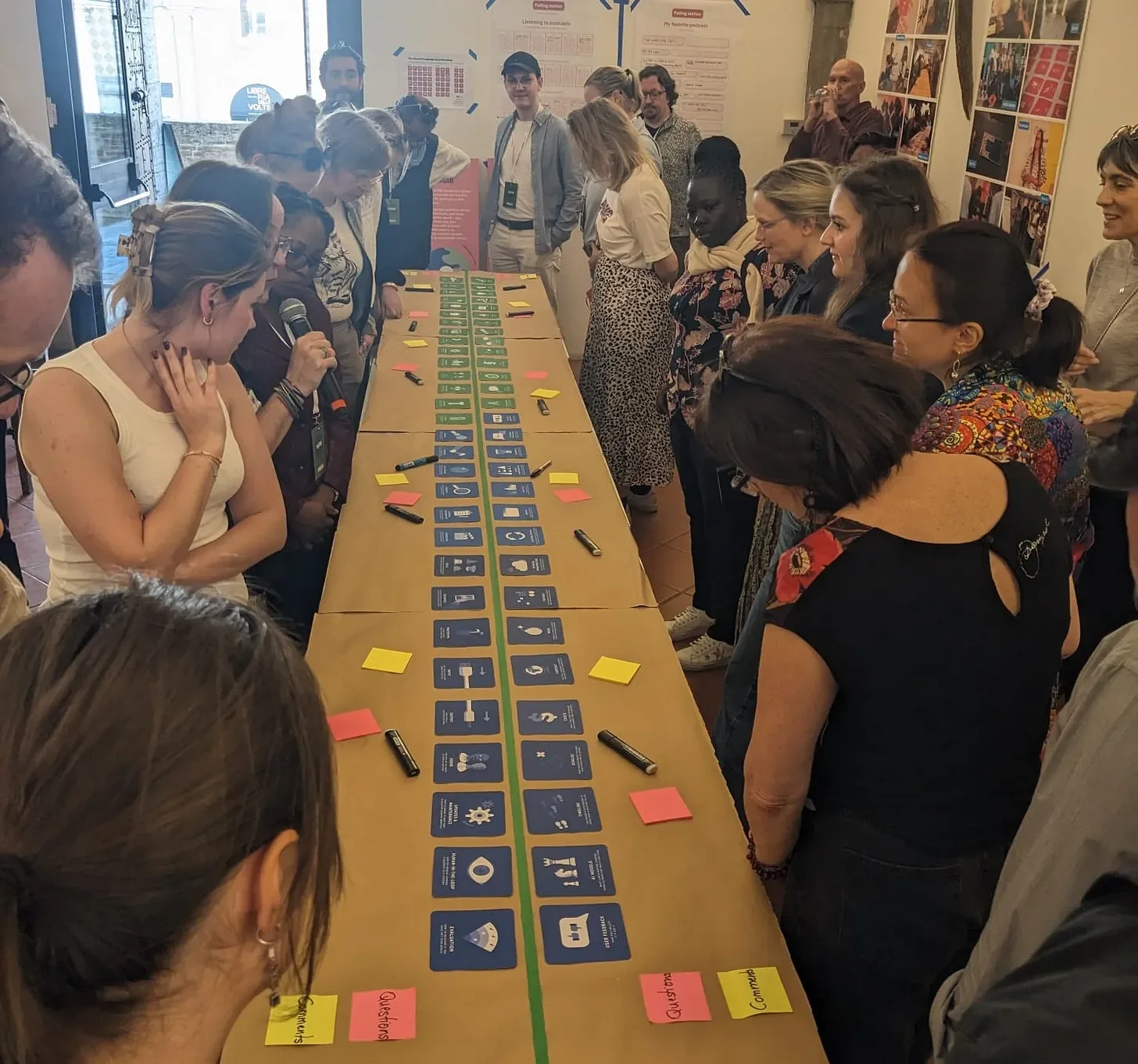
And finally, analogue still exists. The MethodKit for Journalism & AI (which I advised on) shows that structured conversation and deliberation can lead to innovative project design. I gave a workshop with Barbara Gruber and Michelle Nogales demonstrating how this deck of 75 cards can help you plan and design an AI strategy for a newsroom. You can download the deck for free and soon you will be able to order the physical deck as well.